Cabarrus Amateur Radio Society

Cabarrus County, Concord, NC


First Field Test of the Antenna Launcher
Disclaimer
The information provided in this article is for educational and informational purposes only. The author and publisher assume no responsibility or liability for the construction, use, misuse, or results of any device built using this information. Any construction or operation of devices involving pressurized systems or projectile launchers carries inherent risks.

Anyone choosing to build or operate equipment based on this information does so entirely at their own risk. The builder/operator is solely responsible for ensuring that all materials, construction methods, and operating practices comply with applicable safety standards and local laws.


Saturday the 14th marked the first real field test of my new antenna launcher. The date was no accident—there was no way I was going to attempt something like this on Friday the 13th. My friend William (KR4DRH—aka “Dr. H”) joined me, and we got started around 9:30 in the morning. The plan was straightforward: put the launcher through its paces, record some video for the website, and—most importantly—get support lines up for my upcoming fan dipole and a delta loop antenna system.

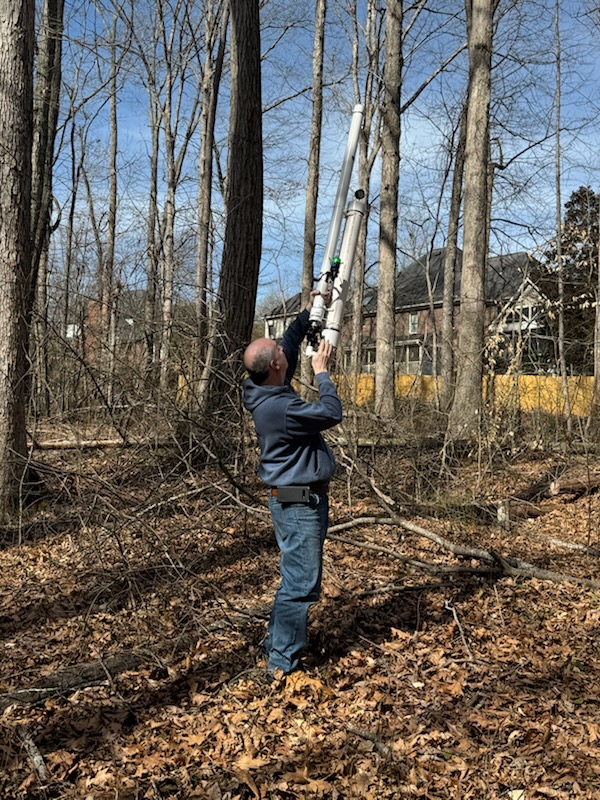
We began with a simple vertical test shot. The chamber was charged to just 40 psi, pulling a 10-lb monofilament line. The trees around my property are all at least 100 feet tall, which makes height estimates fairly easy. On that first shot the projectile cleared the treetops by a wide margin—likely reaching somewhere around 200 feet.


Since we wanted to capture the flight on video, we attached a 1-meter strip of red surveyor’s tape to the ball to make it easier to see. Naturally, that added a lot of drag, so we increased the pressure to 60 psi for the next shot. Later we estimated the height by timing the flight. The ball took about seven seconds for a complete up-and-down trip, which again works out to roughly 200 feet of altitude—and that’s with the ball dragging what was essentially a small parachute behind it.

Unfortunately, the video footage didn’t turn out quite as planned. The projectile leaves the launcher at roughly Mach 0.15, which means it disappears almost instantly. Even when you know exactly where to look, the ball simply vanishes in the video. And once it’s 200 feet up, the streamer doesn’t help much either. Still, the footage does capture Dr. H having a great time, which may be the most important part - and you can see the ball at the very end of the video below.


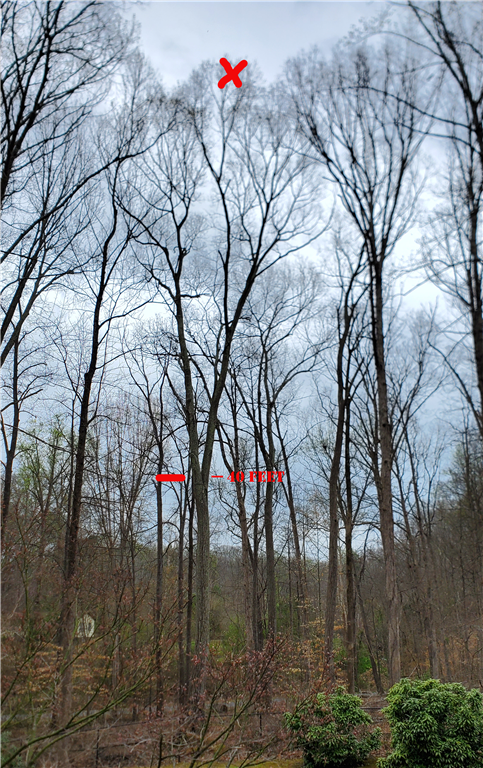
With the basic testing done, we moved on to the real job: getting a line over a 130-foot tree. The target tree (shown below) was selected because it has several strong, well-placed branches that can serve as support points for different antennas. Estimating the heights is fairly straightforward, since the height of the “Y” in the trunk is known to be about 40 feet, which provides a convenient reference point. The "X" marks where the antenna ended up.


It’s worth pointing out that field conditions are never the same as what you deal with in the lab or the comfort of your garage. In the real world you’re dealing with leaves and sticks everywhere, lines tangling unexpectedly, nowhere convenient to sit, and tools you inevitably forgot to bring. That’s why having a well-thought-out, properly prepared kit makes a huge difference. A little planning ahead saves a lot of frustration once you’re out in the field.


That’s where we learned our first practical lesson of the day: always pay attention to what’s on the far side of the tree. More often than not, there are additional branches—and sometimes entirely different trees—waiting there. The higher you launch, the greater the chance that your line will snag somewhere downrange.

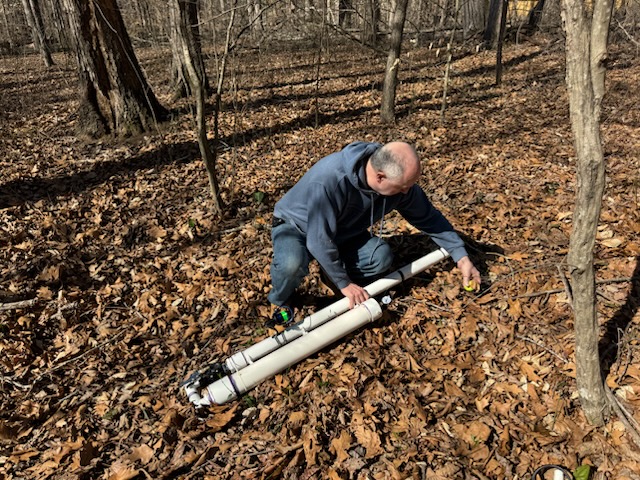
Trying to improve accuracy, I came up with what can only be described as a slightly harebrained idea. I decided to launch at about 75 degrees elevation (see below) using 60 psi, reasoning that the trajectory would be almost vertical and would minimize the droop near the branch we were aiming for.


Well, it worked… but a little too well...

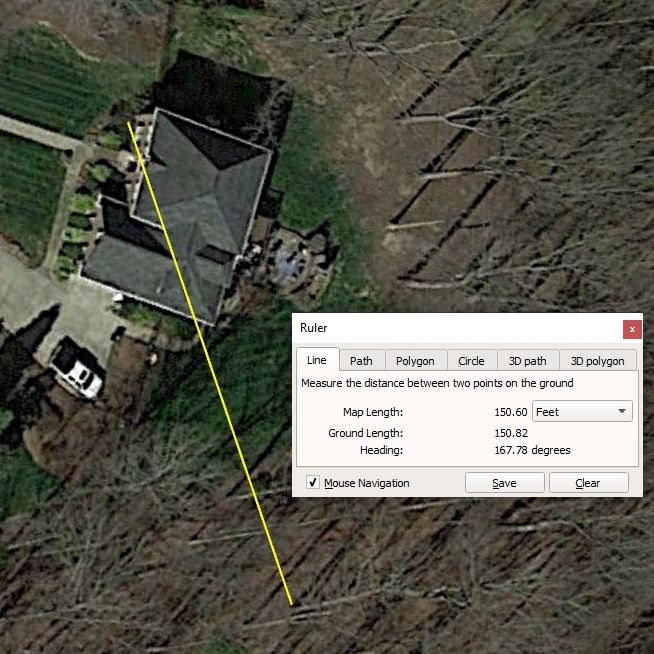
The ball shot upward exactly as planned, cleared the top of the tree—but then kept right on going. It sailed clean over my house and landed roughly 150 feet downrange, a distance later confirmed using Google Earth. After running the numbers, it appears the projectile probably reached an apex of around 300 feet. As it turns out, the performance estimates in my original article may have been a bit conservative.


After that demonstration, we decided to dial things back to a more sensible 40 psi and try again. This time we hit the target on the very first shot.

Once the monofilament line was over the tree, the rest of the process was straightforward. The fishing reel with the 10-lb mono pulled across a stronger twine, which in turn pulled up a 3/8-inch Dacron support line. I intentionally avoided paracord, since it stretches quite a bit and tends to degrade more quickly in sunlight.

With the main line in place, we installed a set of pulleys and secondary lines, essentially the same arrangement used on a flagpole. The final usable support point ended up at roughly 120 feet. That’s well beyond what my 100-foot tape measure can easily verify, so we didn’t bother trying to measure it precisely.

Of course, once you have a 120-foot support point available, it’s impossible not to experiment a little. Just for fun, we temporarily hoisted one end of my 40-meter EFHW antenna from its usual 35-foot height up to around 90 feet. Ultimately this support will carry an inverted-V multiband fan dipole, along with 40-meter and 80-meter delta loops.

Finally, a big thanks goes to my friend Dr. H (William, KR4DRH) for his tremendous help with this project. I couldn’t have done it without him.

This article is reprinted with permission of the author, Christopher Krstanovic - AI2F.
About Author
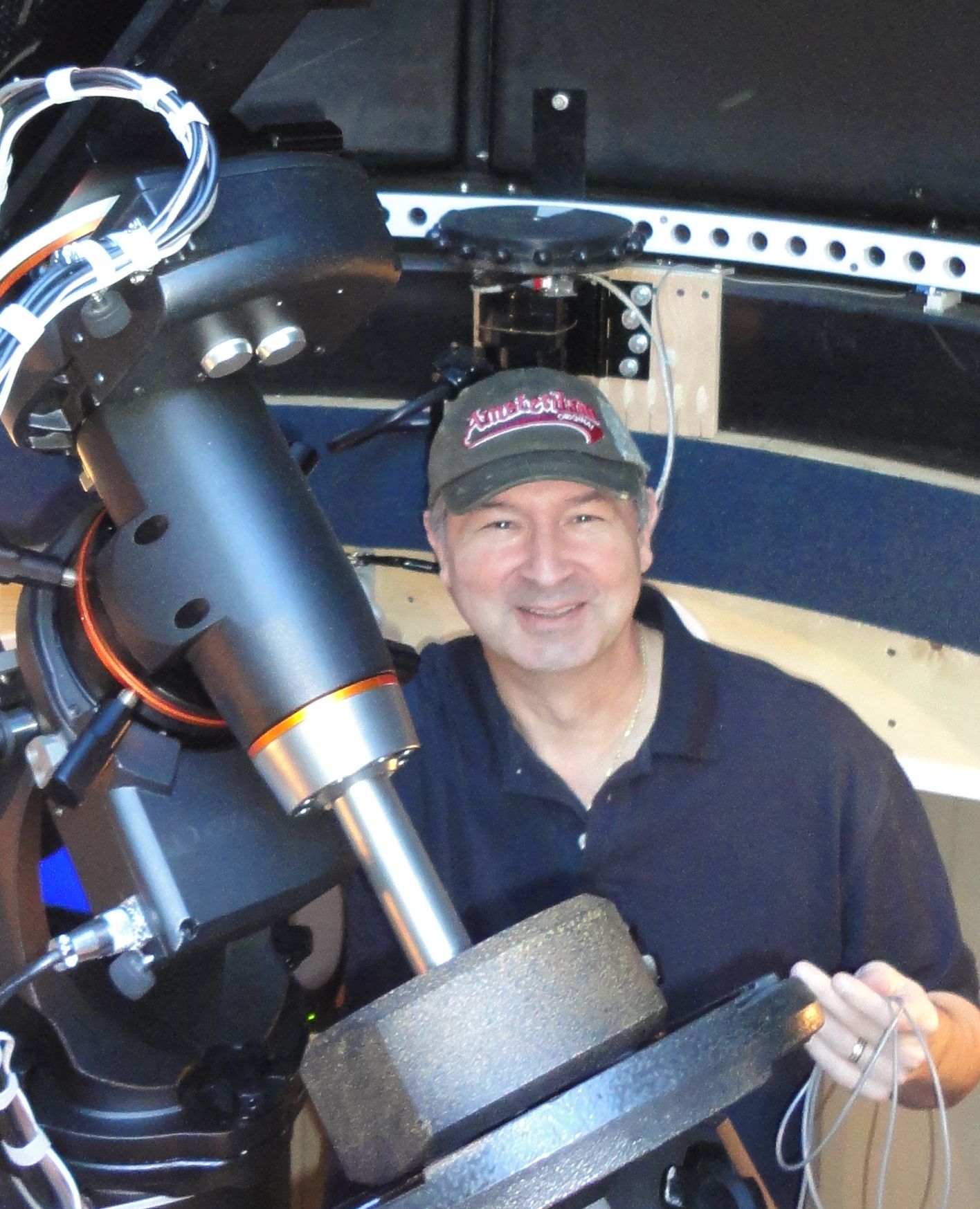
Christopher Krstanovic, AI2F, is a lifelong amateur radio operator, first licensed in the US in 1980s as WR1F. He holds degrees in Physics and a PhD in Electrical Engineering, and his career has spanned corporate engineering as well as technology entrepreneurship. After leaving corporate America, he founded and led three companies before returning to active amateur radio under his current call sign. His operating interests include HF, antenna design, practical radio engineering, Astronomy.


Safety and Liability Disclaimer
The information contained in this article is provided for general educational and informational purposes only. It describes one possible method of constructing an antenna line launcher using commonly available materials. The author and publisher make no guarantees regarding the accuracy, completeness, or safety of the information presented.

Construction and operation of any device that uses pressurized air, mechanical energy, or launches projectiles can be dangerous. Improper design, materials, assembly, or use may result in equipment failure, property damage, serious injury, or death.

By choosing to build or use any device based on the information in this article, the reader acknowledges and agrees that:
• They assume all risks associated with construction and operation.
• They are solely responsible for determining the suitability and safety of all materials and components used.
• They are responsible for complying with all applicable laws, regulations, and safety practices in their jurisdiction.

The author, publisher, and any affiliated organizations disclaim all liability for any damages, injuries, losses, or consequences that may arise from the use or misuse of the information provided.

This material is presented strictly for informational purposes. Construction or use of any device described herein is done entirely at the reader’s own risk.

Organizational Liability Notice
This article may be hosted or referenced by amateur radio clubs, organizations, or websites for informational purposes. The inclusion of this material on any website or publication does not constitute endorsement, approval, or verification of the design.

Any organization hosting or linking to this article, including amateur radio clubs, assumes no responsibility for the construction, use, or misuse of any device based on this information.

All responsibility for design, construction, and safe operation rests solely with the individual builder or operator.
Readers should understand that antenna line launchers and similar devices may be subject to local laws or restrictions. It is the responsibility of the individual builder or operator to ensure compliance with all applicable regulations.


Copyright 2026 © Cabarrus Amateur Radio Society. All Rights Reserved.